
India's macroeconomic situation is certainly better than what it was a year ago, eminent economist Pinaki Chakraborty said on Monday, while expressing hope that the country will be back on the path of economic growth if there is no major third wave of the COVID-19 pandemic. In an interview with PTI, Chakraborty, who is the director of the National Institute of Public Finance and Policy (NIPFP), said that inflation may remain at an elevated level as there was a significant fiscal and monetary expansion in the last 18 months. "The current macroeconomic situation is certainly much better than what it was one year back. We are seeing recovery in most sectors," he said. Chakraborty noted that COVID-19 vaccination has been going on at a very fast rate in India.

The government on Friday came out with Foreign Trade Policy (FTP) 2023 which seeks to boost the country's exports to $2 trillion by 2030 by shifting from incentives to remission and entitlement based regime. Unlike the practice of announcing 5-year FTP, the latest policy has no end date and will be updated as and when needed, said Director General of Foreign Trade (DGFT) Santosh Sarangi while briefing media about FTP 2023. Earlier, Commerce and Industry Minister Piyush Goyal unveiled FTP 2023 which will come into effect from April 1, 2023.
Industry body CII has pitched for a reduction in personal income tax rates, decriminalisation of the goods and services tax and a relook at the capital gains tax rates as part of its agenda presented to the government for the forthcoming Budget. Arguing that the GST law already contains adequate penal provisions for deterrence against evasion of taxes, CII has suggested decriminalisation of GST law. Also, the applicability of prosecution provisions should not be based on the absolute amount of tax evasion but should be based on real intent to evade the taxes and a certain percentage of the tax payable, it stated.

'It has been an ongoing process, talking to the relevant ministries about eliminating leakages and curbing non-core expenditure in various schemes.'

'Once the lockdown is lifted, we will need the mother of all fiscal and monetary policy support to sustain the economy,' advises Akash Prakash.

Moody's Investors Service on Friday said India's economy is expected to contract for the first time in more than four decades saying economic damage owing to the coronavirus-induced lockdown will be significant with lower consumption and sluggish business activity. Even before the coronavirus outbreak, Indian economy already was growing at its slowest pace in six years and with the stimulus measures announced by the government falling short of expectations, the disruptions are likely to be greater. "We now expect India's growth to register a real GDP contraction for the fiscal year ending in March 2021 (fiscal 2020-21), from our earlier projection of zero growth," it said in a research note.

West Bengal, the chief minister said, cannot be compared with other states and despite all hurdles it had an increased revenue generation over the last three years from Rs 21,000 crore (Rs 210 billion) to Rs 40,000 crore (Rs 400 billion).

The government plans to raise resources to finance capital spending beyond the Rs 3.10 lakh crore budgeted for 2017-18 through higher borrowing or divestment receipts.
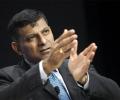
The Indian economy has "some bright spots and a number of very dark stains" and the government should target its spending "carefully" so that there are no huge deficits, noted economist and former RBI Governor Raghuram Rajan said on Sunday. Known for his frank views, Rajan also said the government needs to do more to prevent a K-shaped recovery of the economy hit by the coronavirus pandemic. Generally, a K-shaped recovery will reflect a situation where technology and large capital firms recover at a far faster rate than small businesses and industries that have been significantly impacted by the pandemic.
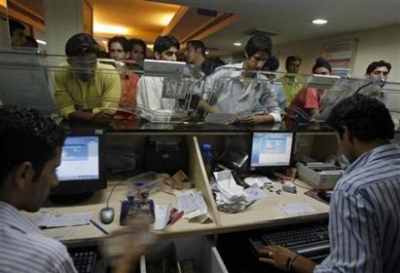
Arun Jaitley addressed a post-Budget press conference.

'One way of doing this could be offering credit guarantee to the banks, say 10 per cent, for fresh loans given to micro, small and medium enterprises,' observes Tamal Bandyopadhyay.

'If such inflows materialise, what will be the effect on the rupee's value -- and therefore on exports growth, the only sustainable path to recovery?', asks Mihir S Sharma.

The vaccination drive was only one important part of India's globally recognised pandemic management and response strategy, observes Dr Vinod K Paul.
Fitch reaffirmed India's rating at 'BBB-' with a Stable Outlook saying the rating balances a still strong medium-term growth outlook compared with similar category peers and relative external resilience stemming from solid foreign-reserve buffers against high public debt, a weak financial sector and some lagging structural factors, including governance indicators and GDP per capita.
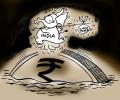
India's public debt ratio, which remarkably remained stable at around 70 per cent of the GDP since 1991, is projected to jump by 17 percentage points to nearly 90 per cent because of increase in public spending due to COVID-19, the IMF said.

'Will Mr Jaitley listen, or is that expecting too much in pre-election season?' asks T N Ninan.
An appropriate policy response always warrants a correct diagnosis of the problem. That is why the recent trend in inflation and its causes, and the inflation outlook take on exceptional importance ahead of the RBI's policy review on January 25.

IMF Chief Economist Gita Gopinath also said the pickup in global growth for 2020 remains highly uncertain as it relies on improved growth outcomes for stressed economies like Argentina, Iran, and Turkey and for under-performing emerging and developing economies such as Brazil, India, and Mexico.

The National Company Law Tribunal (NCLT) on Thursday reserved its order on crisis-hit airline Go First's plea seeking voluntary insolvency resolution proceedings and interim moratorium on financial obligations while aircraft lessors vehemently opposed the petition. Amid the airline facing severe financial crunch and cancelling flights, a two-member NCLT bench comprising Justice Ramalingam Sudhakar and Member L N Gupta heard the arguments for and against the petition for nearly four hours. As aircraft lessors opposed the plea, the counsels for Go First said the petition was not a malicious one to avoid payment of dues to its creditors but to save the company.

'We will not compromise on it. We will not make any deferred payments or cuts.'

After unseasonal rains, supply disruptions and pandemic-induced woes pushed retail inflation well over the Reserve Bank's comfort zone in 2020, the scenario is likely to stay that way at least in the short term as economic recovery slowly gains foothold. For most part of this year, pricier food items pushed the retail inflation, based on Consumer Price Index (CPI), higher in the range of 6.58-7.61 per cent, except for March when the reading was 5.91 per cent. Experts believe retail inflation is likely to average around 6.3 per cent this fiscal and mostly will remain sticky going forward owing to pick-up in demand across sectors.

Amid rising geopolitical risks, a vast majority of Indian CEOs have indicated in a survey that they are reducing or planning to reduce operating costs, even as they are more upbeat than their global peers on their country's economic prospects. However, most of the companies do not plan to cut their headcount or salaries, found the annual Global CEO Survey released by consultancy giant PwC here on the first day of the World Economic Forum meeting on Monday. The survey also found that about four in ten CEOs (40 per cent of global and 41 per cent of India respondents) do not expect their companies to be economically viable in 10 years if they continue on their current path.

Accelerating inequality, the market dominance of tech platforms and remote working are likely to be the longest-lasting legacies of the COVID-19 crisis, the WEF said in a report on Monday. Releasing its Chief Economists Outlook report during the online Davos Agenda Summit, the WEF said that beyond managing the pandemic and vaccine rollout, these trends could shape a new era of fiscal, monetary, and competition policy. Deglobalisation is seen as the least likely of the current trends to continue in the longer term; particularly as international coordination is key to resolving global challenges such as vaccine manufacturing and distribution.
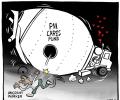
India Inc's philanthropic spends have grown by 3.62 per cent to Rs 22,000 crore in FY21 as profits expanded, and a majority of the allocations have been done to pandemic-linked causes, a report said on Tuesday. The report by rating agency Crisil said that while the first wave saw greater spending in cash largely through the PM-CARES Fund, the preference shifted to more direct support through in-kind spends in the second wave. Corporate contributed only Rs 85 crore to the PM-CARES Fund during the second wave between March and June 2021, as against Rs 831 crore to what was classified as 'others'.

Surplus liquidity in the banking system as measured by absorption of excess funds by the Reserve Bank of India (RBI) fell sharply at the end of the last week due to outflows on account of advance tax payments. According to the RBI data, the net liquidity absorbed by the central bank on September 16 was at Rs 3,243.57 crore, much lower than the average of Rs 56,809.92 crore in the preceding four days of the week. The average absorption of funds by the RBI so far in September is at Rs 1.13 trillion, against the average of Rs 1.2 trillion in the previous month, the data showed.
If the real economy is indeed looking up, then it no longer needs hand-holding and fiscal laxity

For all its claims to economic glory, the majority of India's population lives vulnerable lives, a situation that has only worsened over the past 15 years, to the extent that the government now fears to release economic data or even conduct a proper Census, notes Rathin Roy.

Lower interest rates needed to boost manufacturing, officials say.
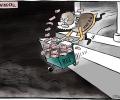
After the RBI surprised the Centre with a record Rs 99,122 crore in surplus transfer for FY21, analysts said this will help the government tide over the revenue losses from lockdowns and extend more support to the pandemic hit industries and to the poor people. In fiscal 2020, the RBI had paid only Rs 57,128 crore in dividend to the government and the finance minister had budgeted only Rs 45,000 crore from the central bank. The higher payout followed the Bimal Jalan panel report that had set a new economic framework capital buffer for the central bank along with the contingency risk buffer at 5.5 per cent.

Elections may be a few months away, but the government may get into election mode much earlier than that, predicts A K Bhattacharya.
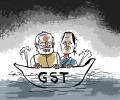
'Because of the COVID-19 pandemic situation today, the revenues of the states have gone down, the GST money is not coming and all the states combined have lost more than Rs 365,000 crore in revenue.' 'To make it worse, the Government of India is not compensating us for the shortfall, which it must as per its Constitutional obligations.'

'Most of the measures the finance minister announced will take effect after the lockdown.' 'By that time, millions of people will be starving.'

It was touted as a game changer but big-ticket privatisation has been a mixed bag as the government faces unanticipated challenges of lukewarm investor response, employee union agitation and legal hurdles. Prime Minister Narendra Modi's often-repeated statement 'the government has no business to be in business' guided the drawing up of an ambitious privatisation pipeline. While Air India sale succeeded, Bharat Petroleum Corporation Ltd (BPCL) divestment failed.

The remarks by Naidu in his last address as the country's Vice President came even as Telangana's ruling Telangana Rashtra Samithi RS said the welfare of poorer sections of society is not a freebie and that welfare measures taken by governments should continue.
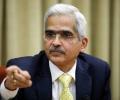
RBI governor Das flags growth slowdown, deputy raises alarm on inflation

'In a serious fiscal situation like this, an ostrich-like focus on annual budgeting, event management and defensive rhetoric will only make matters worse,' warns Rathin Roy.

IT major Tata Consultancy Services (TCS) has made changes to its leadership roles in North America. As part of the changes Suresh Muthuswami has been elevated to the role of chairman, North America, said sources in the know. This is one of the most significant leadership changes the company has announced for the region. The reason for the changes in the North American region, the largest in terms of revenue for TCS, is because Surya Kant who has been at the helm of North America for the past 16 years is stepping down by the end of the fiscal year, as he retires.

The fall in the employment rate translated into a 2.6 million fall in absolute employment between December 2022 and March 2023. Most of this fall was in March 2023.

'This solid verdict would further strengthen his resolve to drive forward the economic agenda to ensure that the fruits of the economic momentum continue to reach the poor, so visible during the last five years.'

Moody's Investors Service on Tuesday slashed India's growth forecast for the current financial year to 9.3 per cent saying that the second wave of coronavirus infections hampers economic recovery and increases risk of longer-term scarring. Moody's, which has a 'Baa3' rating on India with a negative outlook, said obstacles to economic growth, high debt and weak financial system contrain sovereign credit profile. The US-based rating agency had in February forecast a 13.7 per cent economic growth for the current fiscal (April 2021-March 2022).
